
Which VR Glasses Are the Best?

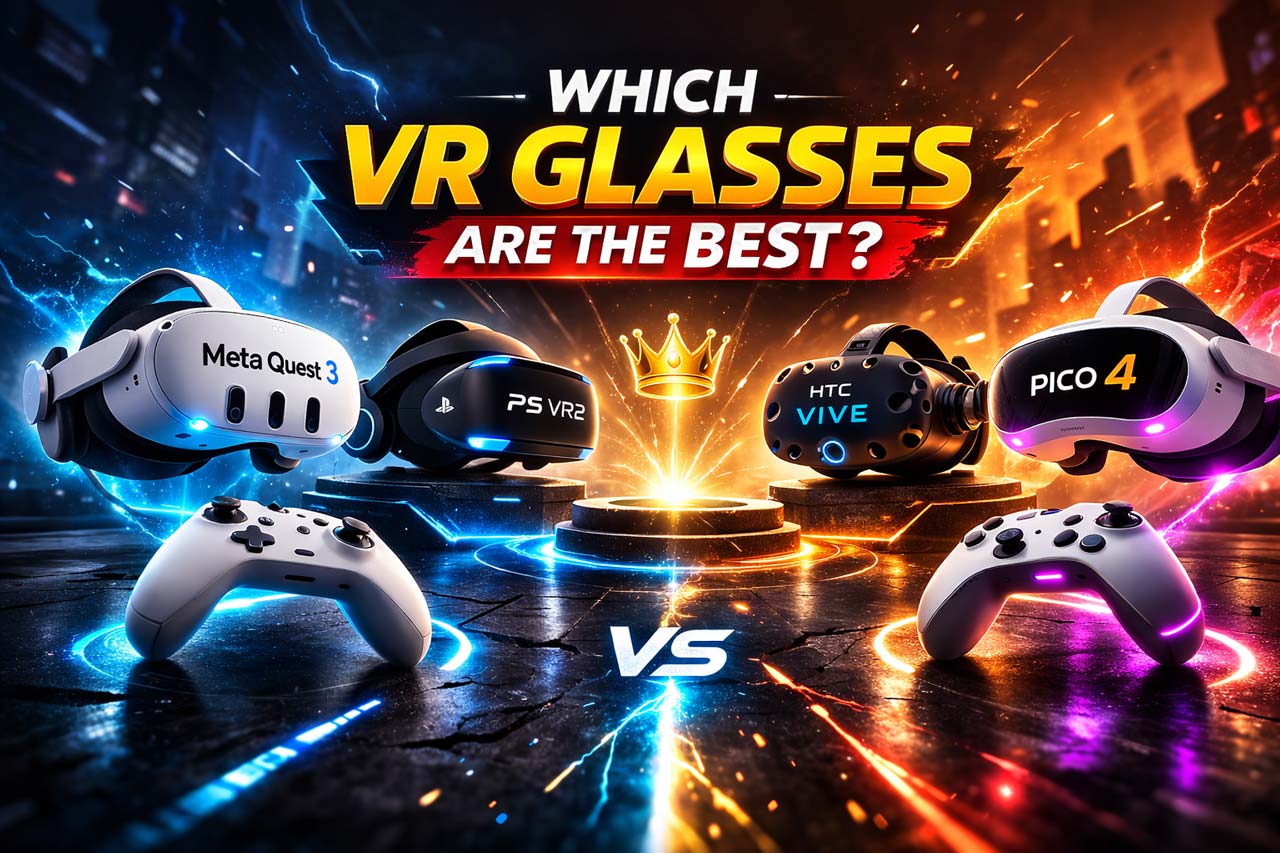
Best VR Glasses of 2026: Top Headsets Compared
Finding the best VR glasses in 2026 means weighing comfort, display quality, price and the type of experience you want. Manufacturers like Meta, Apple, Sony and HTC have each released headsets aimed at different segments, from entry‑level to premium mixed‑reality. Below, you’ll find detailed comparisons of the most noteworthy models so you can decide which one suits your needs.
1. Meta Quest 3 S – Best Overall and Best Budget
The Meta Quest 3 S, released in mid‑2025, is widely regarded as the best value VR headset on the market. It’s a stand‑alone device that combines ease of use with solid performance at an affordable price. Its LCD displays offer 1,832 × 1,920 pixels per eye with refresh rates up to 120 Hz, delivering clear, smooth visuals. The headset uses inside‑out tracking, so no external sensors are needed, and the latest Snapdragon XR2 Gen 2 processor provides responsive gameplay.
Pros:
· Affordable price; excellent entry point for first‑time users.
· Compact and comfortable design with improved head strap over earlier models.
· Robust library of games and apps through the Meta Quest Store.
· Wi‑Fi 6E and USB‑C connectivity; supports PC VR via Quest Link cable.
Cons:
· Uses Fresnel lenses and an older display technology, resulting in lower sharpness compared with the Quest 3.
· Short battery life of around two hours.
· Lacks a 3.5 mm headphone jack; reliance on built‑in speakers.
2. Apple Vision Pro – Best Premium VR/MR Headset
Apple’s Vision Pro represents the cutting edge of mixed reality. While technically more of an augmented reality (AR) device, it supports immersive VR experiences and sets new standards for hardware and software integration. Micro‑OLED displays deliver extremely sharp visuals with pixels so small that individual dots are virtually invisible. Apple’s eye‑ and hand‑tracking system allows you to navigate menus and apps without controllers, and the device integrates seamlessly with Macs and iPhones.
Pros:
· Exceptional display quality and low‑latency passthrough video.
· Innovative eye‑ and hand‑tracking interface that feels intuitive.
· Immersive 3D movie playback and spatial photos.
· Works well with Apple’s ecosystem; ideal for mixed‑reality productivity.
Cons:
· Very expensive compared with other headsets.
· Limited app library at launch; major apps like YouTube and Netflix may be absent.
· Tethered external battery can be cumbersome.
3. Meta Quest 3 – Best Stand‑alone VR Headset
The Meta Quest 3 offers higher‑end features than the 3 S while remaining a stand‑alone device. It uses compact pancake lenses and dual LCD panels delivering 2 K resolution per eye (2,064 × 2,208). A wider field of view (110 degrees) and depth sensor improve immersion and mixed‑reality experiences. The headset also has a 3.5 mm headphone jack for better audio options.
Pros:
· Sharper displays and wider field of view than the Quest 3 S.
· Pancake lenses reduce glare and weight; includes manual IPD adjustment.
· Depth sensor allows apps to anchor virtual windows in physical space.
· Supports wired and wireless PC VR connections.
Cons:
· Costs around $200 more than the Quest 3 S.
· Battery life remains around two hours.
· Mixed‑reality features are still limited and rely on app support.
4. PlayStation VR2 – Best for Console Gaming
Designed exclusively for the PlayStation 5, Sony’s PlayStation VR2 pairs a high‑resolution OLED display with precision controllers. The headset offers 4K HDR visuals (2,000 × 2,040 pixels per eye), a 110‑degree field of view and haptic feedback in both the headset and the Sense controllers. Its single USB‑C cable makes setup easy.
Pros:
· Stunning visuals with HDR support and deep blacks thanks to OLED.
· Comfortable fit and well‑balanced headband.
· Sense controllers feature adaptive triggers and advanced haptics.
· Exclusive games like Horizon Call of the Mountain and Gran Turismo 7.
Cons:
· Requires a PlayStation 5; not compatible with PC or stand‑alone use.
· The headset’s cable can limit freedom of movement.
· Limited library compared with PC VR or Meta’s ecosystem.
5. HTC Vive Focus Vision – Best PC VR Headset
The HTC Vive Focus Vision is a mixed‑reality headset that shines when tethered to a gaming PC. It offers a sharp 5 K display and a wide 120‑degree field of view. Unlike most stand‑alone headsets, it features hot‑swappable batteries for extended sessions. Eye and hand tracking improve interaction precision.
Pros:
· Crisp, colourful visuals and wide field of view.
· Comfortable design with swappable batteries for longer play sessions.
· Strong tracking performance for both head and hands.
Cons:
· Uses an older Snapdragon XR2 chipset, which limits standalone performance.
· Relies on Fresnel lenses, which can cause edge distortion.
· Expensive compared with other PC VR options.
6. ByteDance Pico 4 Ultra – Best Alternative Stand‑alone Headset
The Pico 4 Ultra competes directly with Meta’s offerings. It features LCD pancake displays with 2,160 × 2,160 resolution per eye, a 105‑degree field of view and 12 GB of RAM. Built‑in Wi‑Fi 7 allows high‑bandwidth wireless streaming.
Pros:
· Great display quality and comfortable fit.
· Competitive price with better specs in some areas than the Quest 3.
· Lightweight design with textured controllers.
Cons:
· Pico’s software library is smaller than Meta’s.
· Not available in the United States as of early 2026, limiting accessibility.
· Some light leakage and less accurate tracking than top competitors.
7. Xreal One Pro – Best Portable AR/VR Glasses
If you prefer glasses‑style devices over bulky headsets, the Xreal One Pro offers a taste of spatial computing. While technically AR glasses, they support projected virtual screens up to 32:9 aspect ratio. A micro‑OLED display and a dedicated X1 chip provide clear images and built‑in six‑degree‑of‑freedom (DoF) tracking.
Pros:
· Sleek, lightweight design suitable for travel.
· Wide field of view for glasses (57 degrees) and sharp micro‑OLED display.
· Built‑in hardware for spatial tracking; optional “Beam Pro” accessory enhances features.
Cons:
· Expensive for an AR headset and lacks onboard computing.
· Limited app ecosystem compared with VR headsets.
· Field of view is narrower than true VR headsets.
Choosing the Right VR Glasses
“Best” is subjective when it comes to VR glasses. If you’re on a budget or new to VR, the Meta Quest 3 S delivers excellent value and ease of use. For the best visuals and premium features, Apple Vision Pro leads the pack, albeit at a high price. Gamers with a PlayStation 5 will love the PS VR2’s immersive display and haptic controllers, while PC gamers should consider the HTC Vive Focus Vision for its high‑resolution display and swappable batteries. The Meta Quest 3 offers a strong stand‑alone experience with sharper optics, and the Pico 4 Ultra provides a compelling alternative if available in your region. Finally, if portability and mixed reality appeal to you, the Xreal One Pro offers an exciting glimpse into the future of spatial computing.
FAQ
Q1: Which VR headset is best for beginners?
The Meta Quest 3 S is an excellent choice for beginners because it balances price, ease of use and access to a large library of games and apps.
Q2: Do I need a PC or console to use these headsets?
Stand‑alone headsets like Meta Quest 3 S and Quest 3 do not require a PC , gaming laptop or console. The PS VR2 requires a PlayStation 5, and PC VR headsets like the Vive Focus Vision need a gaming PC.
Q3: Are expensive headsets worth the money?
Premium headsets like Apple Vision Pro or HTC Vive Focus Vision offer better visuals, comfort and advanced features. They are worth it if you want the highest quality experience and have the budget, but mid‑range options still deliver enjoyable VR.